
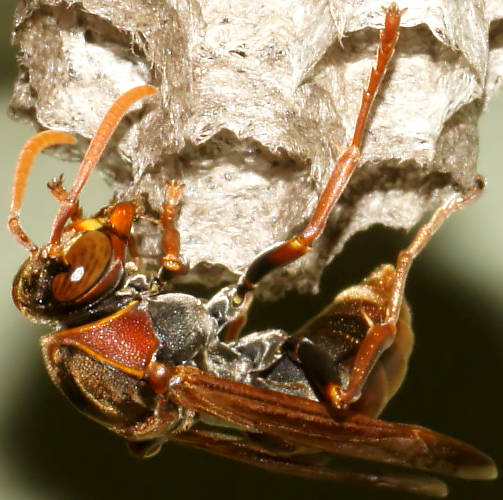
Southern Paper Wasp
Nest, Eggs, some sealed Cells

European Wasp
S3, Worker, dorsal
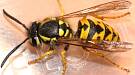
| Southern Paper Wasp Nest, Eggs, some sealed Cells | | European Wasp S3, Worker, dorsal | | ||
 | Class: | Animals (Animalia) - Jointed Legs (Arthropoda) - Insects (Insecta) | |||
| Order: | Ant Bee Wasps (Hymenoptera) | ||||
| Family: | Potter Wasp (Wasp: Vespidae) iNaturalist Observation | ||||
| Species: | Southern Paper Wasp (Polistes humilis ssp humilis) | ||||
| This Photo: | Expanding a cell in the Nest | ||||
Thank you Tony and Jenny Dominelli for confirming the id of this species for us General Species Information: Found in the Flinders Ranges, Adelaide Hills and possibly elsewhere These are known to be aggressive, but only if you disturb their nest. Unfortunately gardeners often don't realise a nest is in the hedge they are trimming until they are attacked. Jonathan Hoskins said "The two subspecies do divide fairly decently by location (ssp humilis is the more southern range, ssp synoecus is more northern and the only one introduced to Western Australia). In terms of appearance, ssp humilis is darker with fewer yellow markings on the abdomen and no yellow lines on the propodeum (the rear portion of the thorax). Ssp synoecus is more yellow with more extensive yellow on the thorax and paired yellow lines on the propodeum." James C. Trager said "Males have the yellow faces and curly-tipped antennae." Iskander Kaliananda said "Nests are the product of one dominant Foundress and everyone living there are her children." As such, the Foundress is an effective queen of the nest. | |||||
| |||||
| |||||